

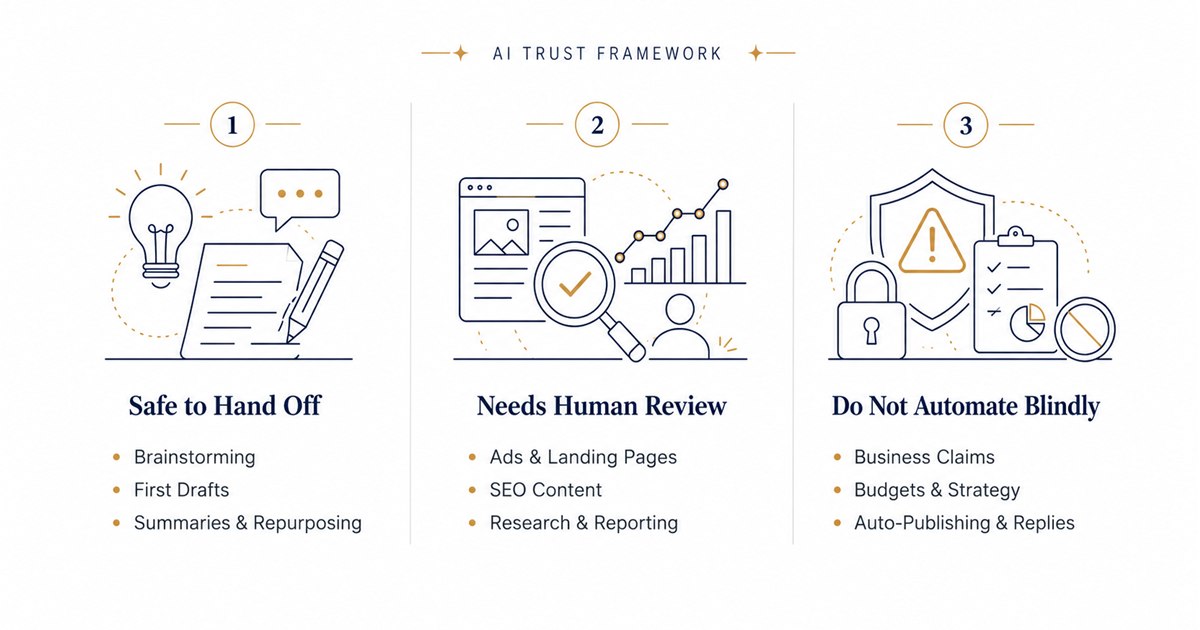
AI can save a serious amount of time in marketing, but that does not mean every task should be handed over without supervision. The real question is whether the work is easy to check, whether AI has the right information, and what happens if it gets something wrong.
Here's the quick version:
- Let AI handle brainstorming, rough drafts, summaries, repurposing, formatting, and repetitive work.
- Keep a person involved with ads, landing pages, SEO content, research, reporting, and anything customers will see.
- Do not let AI control business claims, regulated messaging, customer responses, budgets, strategy, or anything that publishes automatically.
- Give it real context. Better instructions and source material produce better work, but they do not replace human judgment.
That is the line this article explores: where AI saves time, where it needs supervision, and where giving it too much control creates unnecessary risk. To understand why the line sits where it does, it helps to start with how these models actually produce an answer.
How These Models Actually Work
A language model isn't a database that looks things up. It's an education. The model has read most of the public internet, and when you ask it for something, it doesn't retrieve an answer. It samples from that general education, statistically, and assembles the most plausible response it can.
That one fact explains almost every AI failure you'll ever see. If the model hasn't been fed the exact knowledge a job needs, it doesn't leave a blank. It pulls a random sampling from everything it has ever read about businesses like yours, and writes something fluent, generic, confidently close, and specifically wrong. AI doesn't fail loudly. It fails politely. It knows the public past: everything published before its training ended. It has never seen your private present: your Search Console data, your margins, your client's history, this week's numbers.
But that same fact is also the opportunity, and it's the part most articles miss. Feed the model the exact knowledge the job needs, wrap it in project instructions that a person has written, tested, and iterated for your business, and the output transforms. It stops sampling the general internet and starts working from your reality. Properly implemented AI and out-of-the-box AI are not the same tool, even when it's the same model underneath. AI is only a stranger if you keep it a stranger.
So before anything ships, we ask two questions: did we give it the exact knowledge this job needs, and is a person steering?
A quick gut check: if AI handed you the output right now and you published it without looking, what's the worst that happens? If it's "nothing, that's easy to fix," let it run. If it's "we mislead a customer" or "we make a claim we can't back up," that's a person's job.
AI Trust Framework
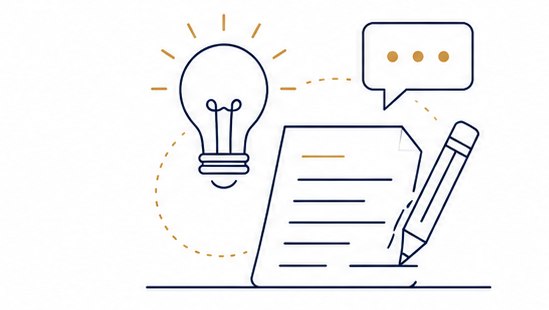
Safe To Hand Off
- Brainstorming
- First Drafts
- Summaries & Repurposing
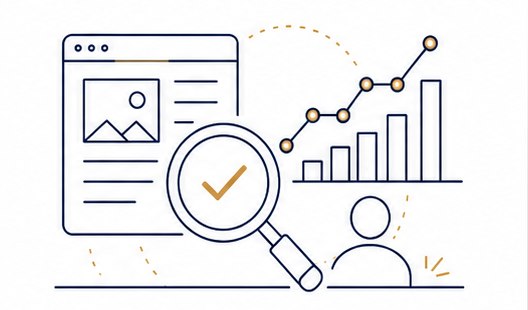
Needs Human Review
- Ads & Landing Pages
- SEO Content
- Research & Reporting

Do Not Automate Blindly
- Business Claims
- Budgets & Strategy
- Auto-Publishing & Replies
Green Light: Where AI Runs Well
These tasks are safe to hand off with light instruction. A mistake is cheap and obvious, so let AI move fast.
Brainstorming
30 blog topics, 20 headline options, a dozen campaign angles. Volume is the point, and you pick the winners.
Rough First Drafts
A fast first pass on almost anything, written with the full expectation that you rewrite it.
Repurposing
One blog post becomes five social posts. A long page becomes a meta description. Same facts, new shape.
Summarizing
Call notes, a long PDF, a competitor's page. When you supply the source, the summary stays honest.
Categorizing And Logging
Tagging leads, structuring data, documenting processes. Tedious for people, effortless for AI.
Formatting And Cleanup
Outlines, alt text, spreadsheet formulas, schema markup. Mechanical work that's easy to check.
Even in the green zone, context is a multiplier. Ask AI cold for 20 title options and you'll get 20 decent, generic ones. Feed it your Search Console queries, your sitemap, and your competitors' pages first, and you get the titles you actually need. Briefed like a team member, it does the work of one. That's the difference between using AI and implementing it.
Yellow Light: A Power Tool, Not A Pilot
In this tier, AI is a genuinely powerful tool in a human's hands, and it's honestly a little crazy to let it run by itself. It will get you eighty percent of the way. The last twenty percent is where it bites: a made-up statistic, an off-brand line, a claim that breaks ad policy. Let it draft, but a person signs off before anything ships.
Ad And Landing Page Copy
Fast variations, real time savings. But cut the "guaranteed" and "#1" claims before they become an ad policy problem.
SEO Blog Posts
Strong drafts, invented citations. Fact-check hard, because AI fabricates studies and stats that look completely real.
Email Campaigns
Great for structure and speed. A person checks the voice and the spam trigger words before anything sends.
Keyword And Competitor Research
A hunch, not data. It will confidently name competitors and search volumes that don't exist.
Client Report Write-Ups
Feed it the real numbers first, then check every figure against the dashboard before it ships.
Automated Ad Platforms
Performance Max and its cousins are AI too, and they'll happily spend your budget on their own goals.
That last one fills entire forums. In one widely upvoted r/PPC thread, an advertiser watched Performance Max burn through half a $400 daily budget by 9 AM on visitors that looked like bots and bought nothing. Others report fake calls making up most of their leads, and Google's newer AI Max features generating ad combinations the advertiser never approved, pairing their copy with irrelevant imagery. The automation isn't evil. It's just optimizing for its metrics instead of your margins, which is exactly why a human reviews the search terms, the placements, and the assets every week.
The rule for this whole tier: AI drives the volume, a human with account access drives the decisions.
Red Light: Keep Your Hands On The Wheel
This is where the cost of getting it wrong is high and the context lives entirely in your business. Don't let AI decide, and never wire it to send.
Claims About Your Business
"We drove 40 leads." "Our CPC is $7." If you didn't hand it the data, it's guessing in public.
Regulated Copy
Medical, legal, financial, or any results promise. Wrong here isn't awkward, it's liability.
Replies To Real People
Reviews, complaints, DMs, PR. AI can draft a response, but a human decides whether it sends.
Strategy And Budgets
What to spend, what to bid, what to cut. Those calls need goals and margins AI can't see.
Anything On Autopilot
Never connect AI directly to a live account or a customer's inbox. Not even for the easy stuff.
Private Data In Public Tools
Pricing, client lists, unreleased plans. Typed into a public AI tool, they may be gone for good.
If that list feels theoretical, it isn't. In one r/marketing thread, a marketer at a regulated company describes a colleague who bypassed compliance review and used AI to send marketing materials with hallucinated statistics to families of childhood cancer patients. Nobody stopped it, because the output looked professional. That is what a Red Light failure looks like. Not a crash. A send.
When Chatbots Get Hijacked: AI Security In Plain English
Everything on the red list gets more dangerous the moment you wire AI to the outside world, because customer-facing AI reads whatever strangers type at it. Here's the core security problem in one sentence: a language model can't reliably tell the difference between its instructions and the text it's reading. Security researchers call the resulting attack prompt injection, and OWASP now ranks it the number one risk for AI applications.
It's not theoretical. Here's the public record:
- The $1 Tahoe. In December 2023, a visitor told a Chevrolet dealership's chatbot to agree with everything he said, then got it to agree to sell a 2024 Tahoe for one dollar, "no takesies backsies." No car changed hands, but the screenshots went everywhere and the dealer shut the bot down.
- The swearing courier bot. In January 2024, a frustrated customer got DPD's delivery chatbot to swear at him and write a poem about how useless it was. DPD disabled the AI the same week.
- The invented refund policy. Air Canada's chatbot told a grieving passenger he could apply for a bereavement fare after his flight. That policy didn't exist. In February 2024, a tribunal made the airline pay and flatly rejected its argument that the chatbot was a separate entity responsible for itself. Legally, your bot's promises are your promises.
- The city bot that advised breaking the law. New York City's official business chatbot told employers they could take workers' tips and landlords they could refuse housing vouchers. After two years of backlash, the city finally killed it in early 2026.
- The leak you can't undo. Samsung engineers pasted confidential source code into ChatGPT to get quick help, and Samsung banned generative AI tools company-wide within weeks. Anything your team types into a public AI tool may be gone for good, which is why your private present, your pricing, your client data, and your strategy don't belong in one.
Notice the common thread: in every case, the AI had permission to speak or act for the organization with no human in between. Security frameworks like OWASP's Top 10 for AI applications and NIST's generative AI profile call this "excessive agency," and their prescription matches our house rule exactly: give AI the least authority it needs, and keep a human between it and anything real. Even when the bot behaves, overreliance has a bill. Klarna famously said its AI assistant was doing the work of 700 agents and that it had stopped hiring because of AI, then reversed course and brought humans back into support when quality suffered.
AI Slop: What Happens To Content Nobody Reviewed
There's now a word for AI output published without human review: slop. Developer Simon Willison popularized it in May 2024 with a simple formula: slop is to AI what spam is to email. By 2025 it was Word of the Year at both Merriam-Webster and the American Dialect Society. When the dictionaries crown a word for your content strategy, it's time to reconsider the strategy.
Google reconsidered it for everyone. Its March 2024 core update and "scaled content abuse" policy target mass-produced, low-value content "no matter how it's created." The enforcement was not subtle. An Originality.ai analysis counted roughly 1,400 sites hit with manual deindexing in the update's opening weeks, overwhelmingly sites heavy with unedited AI content.
The case studies are brutal:
- A marketer publicly bragged about an "SEO heist": feeding a competitor's sitemap into an AI tool to generate about 1,800 copycat articles, claiming millions of stolen visits. Within weeks of it going viral, Google demoted the site and traffic collapsed below where it started.
- A startup published tens of thousands of AI-generated programmatic pages, got wiped from Google's index, and ended up abandoning the domain entirely, an arc its own founder later recounted and that made the rounds on r/SEO.
- In a 16-month experiment covered by Search Engine Land, 2,000 purely AI-written articles mostly got indexed at first, then sank: by month six only about 3% of pages were still anywhere in the top 100, and 16 months of publishing produced 1,381 total clicks from over a million impressions.
- A Semrush study of 20,000 keywords found human-written content held the #1 position 80% of the time. Pure AI content held it 9% of the time.
Here's the nuance most hot takes miss: Google is not anti-AI. Its own guidance says it rewards quality content however it is produced, and an Ahrefs analysis of 600,000 pages found most top-ranking pages contain some AI assistance. The penalty isn't for using AI. It's for skipping the human.
And even if Google never caught it, your readers would. Hootsuite's consumer research found 62% of consumers are less likely to engage with or trust content once they know AI created it. One more kicker: the U.S. Copyright Office reaffirmed in January 2025 that purely AI-generated work isn't copyrightable. Publish slop and you don't even own it.
How We Close The Gap Before AI Touches Anything Real
The pattern behind every failure above is the same: general AI, no exact knowledge, nobody steering. Closing that gap is the actual work of implementing AI, and it's what happens on every job here.
Every Project Runs On Iterated Instructions
The AI in our workflow is not the AI you get out of the box. Each project runs on meticulous instructions a person wrote: your brand voice, your rules, your no-go list, refined every time we learn something about what works for your business. That instruction set is the difference between general AI and your AI.
We Feed It The Facts First
Before AI drafts a client report or an on-brand page, it gets the exact knowledge the job needs: the real numbers, the brief, the source material. It works from what we give it, not from what it samples.
We Ask For A Draft, Not A Decision
AI proposes and a person disposes. It produces a fast first pass, never the final call on budget, positioning, or anything a client will actually see.
A Human Checks Anything Public Or Factual
Every claim, every public reply, and every regulated line gets read by a person before it goes live. One review pass routinely catches things that would have been embarrassing in front of a client.
It Has To Flag Its Own Guesses
We ask it, plainly, what it would need to verify. A good model tells you where it's improvising, and that list becomes the human's to-do.
Nothing Auto-Sends
There is always a person between AI and a live account or a real customer. That single rule prevents most of the ways this goes wrong, from the hijacked chatbots above to the auto-reply that makes a bad review worse.
What Separates This From Slop
Slop is what general AI produces when nobody briefs it and nobody reads the output. Our model is the reverse of that, and it's the whole reason our tagline reads Human-Led. AI-Assisted. Data-Backed.
In practice: AI drafts fast inside an instruction set built for your business, then people do the part that makes content worth ranking. Claims get checked against sources we logged on purpose, not the model's memory. A named person edits every piece, puts their name on it, and answers for it. The strategy behind it comes from a human who has seen your numbers. The ranking data rewards exactly this hybrid pattern, and it separates content Google's spam policies target from content they leave alone.
So, How Much Should You Trust AI?
Plenty, when it's implemented instead of just used. Let it brainstorm. Let it draft. Let it take the busywork off your plate and hand you a rough version of almost anything in seconds. Brief it well, and watch the quality jump.
But when the task depends on your numbers, speaks to your customers, or makes a decision your business runs on, the prompt is the easy part and the judgment is the job. The companies in the stories above didn't get burned because AI is bad. They got burned because nobody gave it the right knowledge and nobody stood between it and the customer. Putting someone there is what Human-Led, AI-Assisted means in practice, and it's why the good stuff still ships with a person's name on it.