
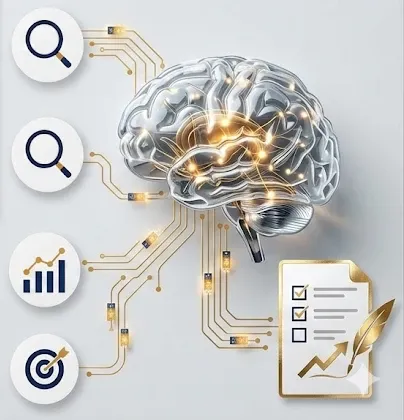
Where People Interact
Every click, call, and page view leaves a trail we can use.
- Service Pages
- Info Pages
- Videos
- Images
- Ads
- Social Media
- AI Chat
How We Use AI
When we onboard you, we tool you up with The Toolbelt: your real data loaded in, worked through a written playbook, and turned into a plain list of what to do next. Claude does the heavy analysis. GPT and Gemini cross-check it. At every step a person asks the hard questions, challenges the output, and signs off before anything reaches you. This is exactly what runs inside it.
How We Use AI
The Toolbelt is our internal AI system for client work, built on Claude Code and run by our team end to end. When we bring you on, we tool you up: your site, your first-party data, and the competitors outranking you, all loaded in and ready to work. Claude is the workhorse for the analysis. GPT and Gemini sit beside it as an enforced adversarial cross-check, reviewing each other and our own methodology before anything ships. On one playbook, that cross-check caught about 35 issues we would have shipped otherwise. We have built websites since 2009, more than 2,000 of them, and The Toolbelt is how a long-tenured team does that work now.
We build a private workspace around your business inside Claude Code, then we put it to work. The AI holds the context across your whole account. We ask the hard questions and decide what the data actually means.
Most sites carry a lot of pages that earn nothing. We pull every one, score it against the data, and put the work where it actually pays back.
Your customers don't only find you on Google. They check Bing, Apple Maps, YouTube, the BBB, your trade association, your license board, and a dozen places you've never thought about. We check all of it, then tell you what's helping and what's quietly working against you.
Most accounts are burning budget on the wrong searches with tracking that can't tell a real lead from a tire-kicker. We fix the measurement before we touch the spend, because a campaign optimizing to broken data optimizes to nothing.
Generic AI content invents statistics, misstates the law, and hallucinates citations. For regulated work that is a liability, not a quirk. So we built knowledge bases the writing pulls from, where every fact traces back to a primary source before it ever lands on a page.
Do You Publish AI Text As-Is?
No. A person reviews and edits everything, against our anti-AI-detection rules, before it goes live.
Do We Own The Final Work?
Yes, all of it. Code and content, in a repository you keep.
Will It Sound Like A Robot Wrote It?
No. We write to your voice, and we'd never ship generic filler.
Measured, Not Guessed
Every page, ad, image, call, and click teaches us something. We use that data to improve the design, content, SEO, ads, and AI visibility of the site. Then those improvements create better data for the next round. That is the loop.
Every click, call, and page view leaves a trail we can use.
We connect the right data sources to see what's working.
We read the numbers with AI at our side, then decide what actually matters.
We fix what the data says matters most, then measure what happened.
Human-Led.
AI-Assisted.
Data-Backed.
We ask the right questions, AI finds the patterns, and our experts make the call.
And the better design feeds the next round of data, so the results keep compounding.
AI on its own gets confident answers wrong, and an expert without it moves too slow to keep up. The work that wins comes from pairing the two, and that pairing is what this page is about.
Run the two apart and each one has a clear weak spot. Put a real expert at the controls of a fully loaded AI and the weak spots cancel out.
Someone good can absolutely find the answer by hand. They just have to read every page, pull every report, and cross-reference it all, which can take days for one site. By the time it's done, the numbers have already moved.
Turn AI loose on its own and it will hand you a clean, certain-sounding plan that's quietly built on the wrong assumption about your business. It rarely admits when it's guessing, and acting on that costs you real money.
Joshua and your account manager bring years of real-world judgment about what actually moves a small business. The AI brings speed and reach across your data. One catches what the other misses.
We've designed over 2,000 websites since 2009, so we already know which fixes pay off and which are busywork. The AI gets pointed straight at the work that matters instead of starting from scratch every time.
Here's what the pairing changes about the work you get and how fast you get it.
The grunt work that used to eat a whole day now takes an hour, so the expert hours go toward thinking instead of digging. You get a sharper read on your site and your competitors than a manual pass would ever reach.
When you ask for a change or a new page, the first draft and the research behind it come back in a fraction of the old time. Less waiting between the idea and the live result.
Recommendations come from your actual Search Console, analytics, and ad data, not from generic best-practice guesses. The advice fits your business, not a template.
A person reads, edits, and signs off on everything before it reaches you or goes live. The AI never gets the final say.
Every article moves through a fixed pipeline before a human ever signs off. Here is the order it actually runs in, and what each step is doing. You can paste any finished piece into your own Claude or ChatGPT and check our work against this. We expect you to.
Before we write a word, we build a voice profile for the client: how they talk, what they say and what they refuse to say, the words a real person at the company would use. Claude writes against that profile so the piece sounds like the business, not like a default chatbot register. The profile is built once per client and reused, so the voice gets more accurate over time, not less.
Claims pull from our source-cited knowledge bases, not from the model's memory. Each fact traces back to a primary source we logged on purpose. If a number or a statement can't be tied to a real source, it doesn't go in the draft. That's the difference between research and confident guessing, and it's our main control against the one failure mode that sinks AI content: a model inventing a fact that sounds right.
We run Gemini Deep Research and OpenAI on the subject, the people already ranking for it, and the questions nobody has answered well. The output tells us where the gap is, so the article fills a hole in the conversation instead of repeating the top ten results.
The draft gets passed between Gemini and OpenAI to critique and rewrite each other's work before a person touches it. One model writes, another tears it apart, the first answers. Models miss their own mistakes, so we make a different model the editor. When the two disagree, or when both miss something, a human editor breaks the tie. That editor checks that every claim still traces to a source, the voice still matches the profile, and the structure still serves the search intent.
We run a mechanical scanner that catches the tells: em-dashes, robotic same-length sentences, the buzzwords and giveaway phrasings that mark machine writing. Anything it catches gets fixed and the scanner runs again until it comes back clean, then a human reads it out loud. The goal is plain: it should read like a person wrote it. The scanner ruleset is ours, built and tuned over months of catching our own output, and it's one of the parts of this that a competitor can't just buy.
Uniqueness, so it's not a reworded competitor. Plagiarism, so nothing is lifted. SEO quality, so structure and intent actually match what people search. And AI-signal quality, a check on whether the writing still pattern-matches as machine output. Fail any one and it goes back.
The AI generates 12 short, optional questions per article and hands them to the client. The client answers the ones where they have firsthand knowledge: a job they ran, a mistake they see customers make, or a detail only an operator would know. That lived experience is what no model can invent. It is also the step where you catch us if we got something wrong.
The finished piece gets a real author attached and goes live in the sitemap, so it's properly attributed and search engines can find and index it. A great article nobody can discover is wasted work. If you want to see the whole chain on one real piece, the ranked article, its source list, the 12 optional client questions and any returned answers, the author attribution, and the scanner's flagged-then-clean output, ask and we'll walk you through one.
Rebuilding a page isn't retyping it. We measure what's there, get more than one expert opinion on how to fix it, and let designers finish the job.
We pull the live page down section by section and grade it against what good looks like: structure, copy, conversion logic, how it actually renders. Grading first means we know which sections are weak and which are fine, so we spend effort where it counts instead of rebuilding parts that already work.
We show OpenAI and Gemini the real rendered section, the actual pixels, and ask each for redesign directions. Two strong models looking at the same section give us competing options to compare instead of one guess to accept. We pick from real choices, and we keep the reasoning each model gave so the call is documented, not vibes.
The AI proposals are a starting point, not the shipped product. Our graphic design team takes the strongest direction and makes it real: brand fidelity, spacing, typography, the judgment calls a model still gets wrong. People own the final look, and every page is signed off by a human before it goes live.
With this method we code pages roughly twice as fast as a hand build, call it 1.5x to 2.5x depending on page complexity, with the grading and cross-model step catching problems early instead of in a revision round. The baseline is our own designers hand-coding the same kind of page. Faster, and the quality bar holds because humans still sign every page.
The speed today is real, but the bigger story is what the architecture does as the models keep getting better. The compounding below is reasoning from how the system is built, not a promised number.
Today the system codes pages about twice as fast as building them by hand, roughly 1.5x to 2.5x by page complexity, observed across our recent builds against our own designers hand-coding the same work. That's the current figure. It's where we are, not where the design tops out.
We engineered the pipeline so each stage calls whatever model is best at that stage, behind a stable interface. When the next Claude, GPT, or Gemini ships, it goes into the slot the old one filled. That swap isn't free: it means re-prompting, regression-testing the new model on real pages, and watching for any task it does worse than its predecessor. The point is that the rework is contained to a slot, not a rebuild of the whole pipeline.
Because each step is wired to the best available model for that step, a strong release doesn't only help one task. It can improve writing, editing, research, and design in the same cycle. A new model usually improves some tasks and sometimes regresses others, which is exactly why we test each swap and route around any step where the new model is worse. Net direction is up, even when a single release is uneven.
Most agencies bolted AI onto a workflow built for humans, so a new model means re-rigging the bolt-ons. Ours was designed model-first from the start, so a swap touches a defined slot and a test pass rather than the plumbing around it. Less rework on our side means the benefit of each release reaches your account sooner than it would at a shop retrofitting AI onto an old process.
Put those together and the lead behaves like a slope, not a single jump. This is reasoning from how the system is built, not a promised number: if frontier models keep improving and our architecture keeps absorbing each one with contained rework, the distance between us and a bolt-on shop should grow with each release, not shrink. We're betting on that, and we built the stack to make the bet pay.
Fair question: anyone can buy the same Claude, GPT, and Gemini APIs. So the tools aren't the moat. The moat is the parts we built and tuned ourselves over months: the per-client voice profiles, the source-cited fact databases, and the anti-AI-detection scanner ruleset. A rival can rent the same models tomorrow. Rebuilding the judgment baked into those three takes a lot longer.
Common Questions
Both, and they're separate things. The AI stack we show on this page is how we run our own shop faster and sharper. AI optimization, also called AEO, is a service we do for you: building your pages so they get quoted inside AI answers like ChatGPT, Gemini, and Google's AI Overviews when someone asks about what you offer. One is our internal tooling. The other is a result we deliver for your business.
A real person, every time. Joshua and your account manager ask the questions, read what the AI returns, push back on it, and decide what's right for you. Nothing reaches you or goes live without a human reviewing and editing it first. The AI is a tool the experts drive, never the one making the calls.
No. We match your voice and we'd never ship the bland filler AI produces on autopilot. The AI helps us work through your data and rough out drafts faster. People do the writing, the editing, and the judgment about what sounds like you, so the finished work reads like a person wrote it because one did.
First, we run a mechanical scanner plus a human read that strips the AI tells (em-dashes, flat cadence, the giveaway phrasings) and loop it until it reads like a person. Second, every article carries firsthand client experience from the question step, which is the E-E-A-T signal Google and AI answer engines actually reward. A clean draft with real operator knowledge behind it is what ranks, and that's what we ship. Paste any piece into your own Claude or ChatGPT and check us.
Claims pull from our source-cited knowledge bases, so each one traces to a primary source we logged on purpose, and you fact-check the article during the question step. Anything that can't be tied to a source doesn't make the draft. If you want to see it, we'll show you a real piece with its full source list attached. You can audit any of it yourself, and we'd rather you did.
You get the upgrade without us rebuilding your pipeline to absorb it. Each stage of our process calls whatever model is best at that stage behind a stable interface, so a new Claude, GPT, or Gemini goes into the slot the old one filled. That swap still takes work on our end, re-prompting and regression-testing the new model on real pages so nothing quietly gets worse, but it's a contained job, not a re-rig of the whole workflow. Shops that bolted AI onto an older process have to redo the bolt-ons every release. Because ours was built model-first, the benefit of each new model reaches your account with less drag and sooner.
Beyond Marketing
The Toolbelt runs your marketing. When your team needs software of its own, our developers build that as well, from lead marking to document pipelines to verified legal databases.
See how we build custom apps for businesses on our vibe coding and app development page.
Tell us what you're after and we'll give it to you straight: what it takes and what it costs. Everything is month to month, so you're never locked in.
Visit Us
Headquartered in Mesa and serving businesses across the Valley and beyond. Stop by, call, or send a note, and we'll get right back to you.