

Vibe Coding & Software Design Consulting

Building Custom Apps For Businesses With AI

Small businesses all end up renting the same handful of tools, and paying every month for software that was built for the average of ten thousand other companies. We have already built our own versions of most of them. You get the base, our developers customize it around how you actually work, and you stop renting.

The Method

Why This Is Possible Now

We are a design and development company. We have always had developers. What changed is how fast a working build comes together, so the tools we used to only build for ourselves are now practical to build for clients too.

We vibe code it, and we will say the quiet part out loud. AI writes better code than we do in some of the advanced languages, and it is faster than any of us at the parts that are mostly pattern. Working with it, we build genuinely good software. Our job is knowing what to ask for, catching what is wrong, and deciding what ships.

Everything lives in a repo, which is what makes that possible. Because the code sits in version control we can put a second and third model on it and have them check each other's work. We run Codex alongside Claude, plus open weight models, and they do not agree as often as you would hope. Where they disagree is exactly where a person should be looking. That is quality control you simply could not run this way a couple of years ago.

So we built the common ones. They are done, they run, and they are on tap.

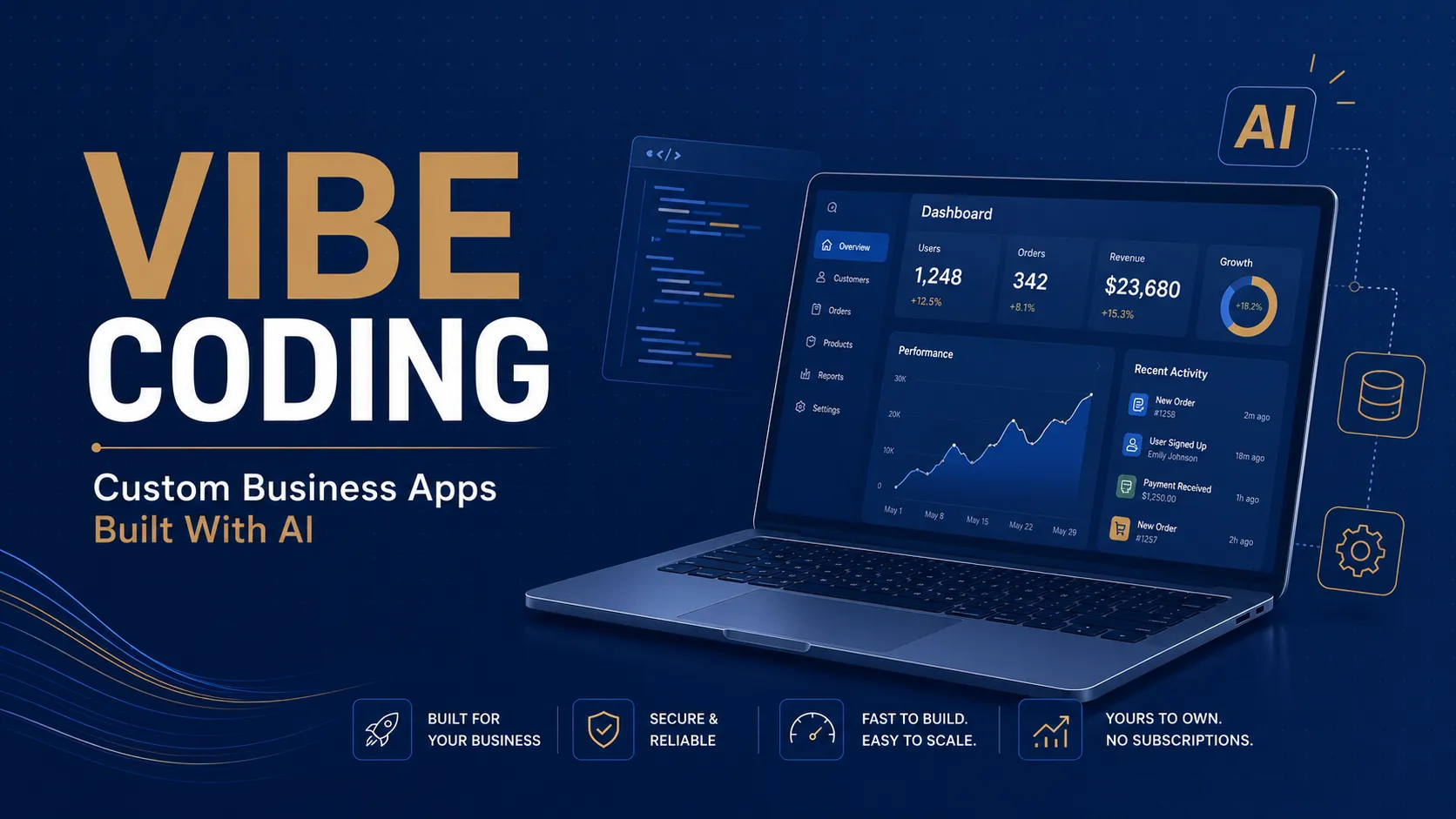
Vibe Coding by My Favorite Web Designs: custom business apps built with AI, shown as a live dashboard on a laptop

The Math

Renting Versus Owning

Rented Software

  • Costs you every month, forever
  • Priced per seat, so it gets worse as you grow
  • Built for the average customer, so about a third of it fits
  • Your process gets bent to match the product

A Customized Build

  • Starts from something we already made
  • Shaped around how your team actually works
  • No rent for the privilege of using it
  • One piece of work, not a subscription that never ends

For most of what a small business needs, the second one is cheaper inside a year and better on day one.

$600/mo

We are our own best example. We replaced two subscriptions that were costing us $400 and $200 a month. That is $600 a month we do not send anywhere now, and the replacements fit our shop better than the originals ever did.

Already Built

What Is Already On Tap

Honest status on each. We do not list what does not exist.

Time Clock & Team Reporting

Live

Staff clock in and out, hours land against the right client or job, and you get a weekly picture of where the time actually went.

Document Intake & Filing

Built For Legal

Documents arrive, get read, get labeled, get filed where they belong, and the finished package routes to whoever needs it next. The first one was built around a bankruptcy intake flow.

Verified Fact Databases

Live

A checked, sourced knowledge base your own AI can lean on instead of guessing. For a law firm that is the real statutes and rules for their practice areas, with citations. We have built these for Arizona business, franchise, employment, real estate and litigation law, plus roofing, dental, pools and plumbing.

Lead Marking

In Build

Every call and form gets reviewed and marked as a real prospect or not, then fed back to Google Ads so it learns what a good lead looks like.

Review Watch

Live

Watches your reviews, flags the ones that look fake, and builds the case to get them removed.

Reporting You Can Read

Live

Your numbers pulled from wherever they live, in one place, in plain language.

A Real One, In Detail

Chief Of Staff, Built For Our Own Team

We have contractors across two countries. We needed to know what work was happening, which client it belonged to, and whether people had what they needed. Every tool we looked at either watched people without telling them, or tracked time without knowing what the time was for. So we built it.

It watches the work, with permission.

A screenshot a minute while the clock is running, downscaled, tagged with what the person said they were working on. Capture pauses on its own after five minutes of no input and picks back up on the next keystroke, so nobody is billing for a coffee break. Nothing leaves the machine until the person clicks Approve And Upload, and they can delete any frame they do not want sent. We chose that on purpose. A monitoring tool people resent is a monitoring tool people work around.

It reads the AI work, which is the new part.

Our team runs Claude Code all day. The system reads those session logs directly: every prompt, the tokens, the exact cost per turn, and which model actually ran versus which one was picked. That last one matters more than it sounds. When a job silently falls back to a more expensive model, we see it now.

It works out whose job it was, by itself.

The system reads the file paths a session touched and turns them into client attribution, weighted. If somebody spent a morning moving between three clients, the session splits three ways by the weight of the evidence, and the cost splits the same way. No timesheet. No dropdown. The work says who it was for.

It knows when the clock is wrong.

If Claude is open and the clock is not running, it says so. There is an opt in to start the clock automatically when Claude opens, and it will never clock anyone out on its own, because closing a window to take a phone call should not silently end your day.

It keeps private data separate from work data, in the schema.

Two databases. One holds the person, their frames and their coaching notes, and never leaves the local machine. The other holds the work, tagged with a rotating token instead of a name, and is the only one anything else can read. A filter sits between them and blocks anything that looks like a name or a screenshot path from crossing. That is enforced in the structure, not in a policy document somebody might ignore.

And here is the part that makes the point about AI moving fast.

Two weeks went by where the screenshots uploaded fine and the AI usage logs did not, and we thought the team simply was not using Claude much. Wrong. Both contractor laptops sat behind a corporate proxy that re-signs secure connections. The screenshots survived because a failed one waits and retries. The usage log fired once a day and gave up, so every failure was permanent and invisible. We found it, fixed the certificate handling, gave the usage logs the same retry behavior, and moved the schedule onto a timer that catches up after a machine has been asleep.

That is the honest version of building software this way. The build is fast. Staying on top of it is the actual job, and it is the reason we would rather be your development shop than sell you a product and disappear.

Why Us

Why Us And Not A Software Shop

We already run your website, and that matters more than it sounds. Most custom software looks like custom software. Somebody's default framework theme, a logo dropped in the corner, buttons that do not match anything else you own. Your team notices, and so does every customer who touches it.

We are the ones who built your brand on the web. So when we build you a tool, the interface comes from the same place your site does. Same colors, same type, same buttons, same feel. Your staff opens it and it looks like it belongs to your company, because it does. Nobody else can offer that, because nobody else has your design system already in hand.

We are also already inside your infrastructure. We know where your site is hosted, who your registrar is, how your DNS is set up, and where your analytics and tracking live. So the plumbing that usually turns into a three week email chain is a Tuesday for us. Standing up a Cloudflare R2 bucket for document storage, adding a worker, wiring a subdomain, putting the tool behind a login, none of that is a project. It is the same infrastructure we are already managing for you.

That is the real argument for having your marketing company build your software. Not that we are cheaper. That it arrives looking like you, running on what you already own, from people who can be reached.

The Process

It Starts As A Conversation, Not A Build

The first job is not writing code. It is working out where AI can actually help your organization, finding the easy and safe wins, and being straight about where building your own makes sense and where it does not.

  1. 01

    We look at where AI actually helps.

    We walk your workflows with you and find where AI saves real time, and where it honestly does not. This part is advice, not a sales pitch. The goal is a clear map of what is worth doing, not a list of things to buy.

  2. 02

    We start with the easy, safe wins.

    Some things are a quick, low risk yes: a small automation, a report nobody has time to pull, a tool that already exists that we can stand up fast. We do those first, so you see value before anything ambitious.

  3. 03

    We tell you when to build and when not to.

    Sometimes the honest answer is that a subscription is fine and you should keep it. Building your own is worth it when a customization genuinely serves you, and when owning it opens the door to using more AI across the business. We will tell you which one you are looking at.

  4. 04

    We customize or build what earns it.

    Where we already have a base, most of the build is done and we fit it to how your team works. Where we do not, our developers build it. Either way it is shaped around your process, because that is what decides whether it gets used.

  5. 05

    You run it, and we stay available.

    Your tool, your data. We are your development shop, so when you want it changed or you spot the next thing worth automating, you call us the same way you do for the website.

Questions

Frequently Asked Questions About AI Development Of Your Own Internal Apps For Business

Are you a software company now?

No. We are a design and development company, and your AI consultants for the software and integrations your business needs. This is our developers building useful things instead of you renting them.

Who owns it?

You do. It is your tool and your data.

Do you support it forever?

We are not selling you a warranty. We are your development shop, so when something needs changing or fixing you call us the same way you do for anything else we build. Ongoing work is quoted like ongoing work.

What does the customizing cost?

Depends what it is. The base already exists, so you are paying for the fitting rather than the whole build, which is the reason this works at all. We will give you the number before we start.

What is 10DLC and do I actually need it?

It is the registration the phone carriers require before a business can send text messages at any real volume. If you want to text customers for reviews or appointment reminders, yes, you need it. It is a genuine hassle and rejections are common, including for reasons that have nothing to do with you. We run the messaging under our Twilio and work through the registration with you. The approval itself is the carriers' decision, so we will not pretend it is ours to guarantee. We stay on it with you until you are through.

Is it secure?

We will tell you where your data lives and what touches it before we build anything. For sensitive material like client documents or call recordings, we can set it up to run inside your office rather than ours.

What if we want something you have not built?

Ask. Most of what is on this page started as somebody asking.

What Are You Renting That Does Not Fit?

Tell us what your team wrestles with, or which subscription annoys you most. We will tell you straight whether we already have the base for it and what customizing it would take.

Visit Us

Find Us In Mesa, Arizona

Headquartered in Mesa and serving businesses across the Valley and beyond. Stop by, call, or send a note, and we'll get right back to you.

Our Studio

10345 E Talameer Ave
Mesa, AZ 85212
Get Directions

Hours Of Operation

  • Monday to Saturday8:00 AM to 8:00 PM
  • SundayClosed