

Ask an AI assistant whether your business should be listed in directories and you'll usually get a version of the same answer: directory links are low quality, Google discounts them, and you should earn real editorial links instead. That answer isn't wrong. It's answering a narrower question than the one you asked, because it grades every listing on one thing, whether it passes link equity, and that's only one of three jobs a listing can do.
Here's the quick version:
- Organic and local rankings run on different inputs. Links are a real factor in organic search. The map pack runs mostly on relevance, distance, and prominence, and a listing's job there is consistency, not equity.
- A listing can help in three places: maps, AI answer engines, and organic search. Most help one or two. Grading all of them on organic link value is how a useful listing gets thrown out.
- Some directories really are bad, and they have tells you can check in about two minutes.
- AI answer engines lean on directories hard when they decide which businesses to name. That's the part the "directories are dead" answer misses completely.
Where That AI Answer Comes From
The models aren't making it up. They're compressing about fifteen years of correct warnings.
In the early 2010s, mass directory submission was a real link scheme. You paid a service, it blasted your business into a few hundred auto-generated sites, and those sites existed to pass link equity and nothing else. Google's link spam policies still name that behavior. The warnings were accurate and they stuck, the same way the warnings about exact-match domains did.
Read the actual policy, though, and the wording is narrower than the summary you get back. The listed example is "Low-quality directory or bookmark site links." Not directory links. Low-quality ones. That qualifier is doing all the work, and it's the first thing to fall out when fifteen years of guidance gets compressed into one paragraph.
What's left is a rule scored on a single axis: does this pass authority to my domain. Under that lens, a fully built Clutch profile and a forty-five-dollar lifetime listing mill score about the same, which should tell you the lens is wrong.
The advice is also describing a world that has since moved. Whitespark has surveyed local search practitioners annually for years, and its 2026 report, published in November 2025, said it plainly: citations spent a decade falling in importance, and AI search has brought them back. Their summary line is that in AI SEO, mentions are the new link. Three of the five factors they rank highest for AI search visibility are citation factors.
Link equity, in one sentence: the ranking value one page passes to another through a link. It's the thing most SEO advice is measuring when it calls a link "good" or "bad," and it's the only thing most of that advice is measuring.
Organic And Local Are Two Different Systems
Google documents local ranking as three factors: relevance, distance, and prominence. Relevance is how well your profile matches what someone searched. Distance is how far you are from the searcher. Prominence is how well known the business is, and links are one input into it, alongside reviews, articles, and directory presence.
Two of those three have nothing to do with your backlink profile. One of them, distance, you cannot change at all. So a link-first strategy pointed at the map pack is pointed at the wrong system.
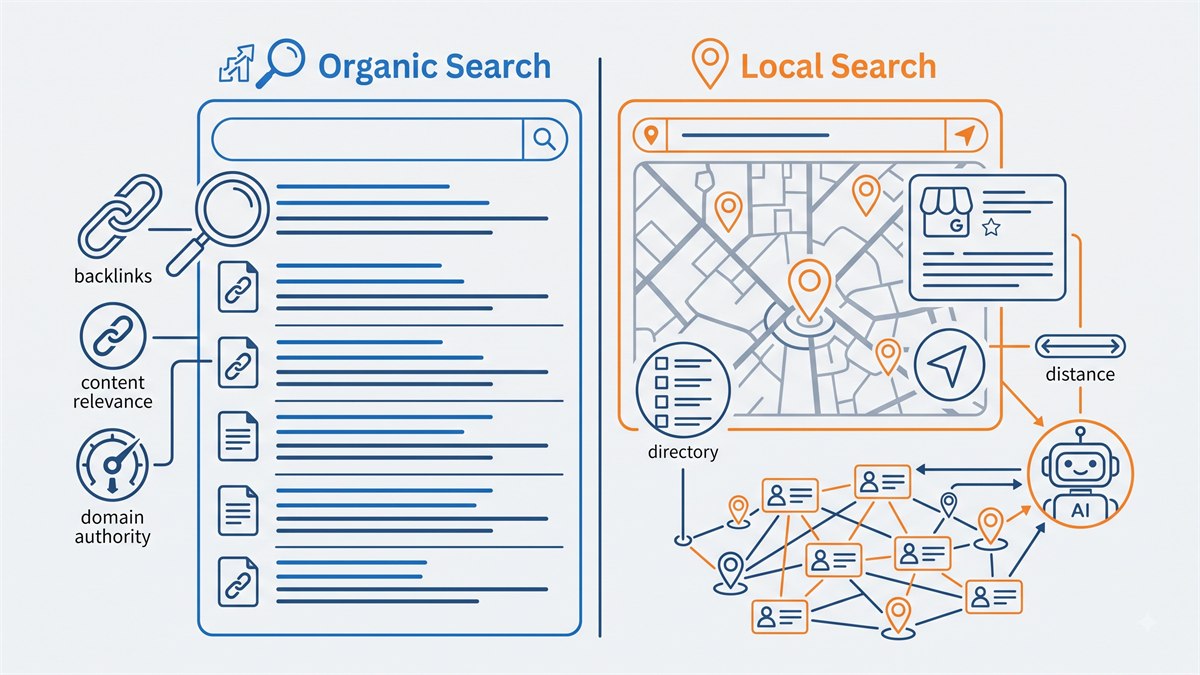
Organic search is ranked largely on backlinks, content relevance, and domain authority. Local search is ranked on distance and relevance, and the directory profiles feeding it are also what AI assistants read when they decide who to name. Same business, two scoreboards, almost no overlap in what moves them.
If you want to see prominence computed rather than described, Google's own patent on scoring local results spells it out. It was granted in 2011, it is titled "Scoring local search results based on location prominence," and the inputs it names include the total number of documents referring to a business and the number of documents carrying reviews of it. Mentions and listings, counted directly, sitting inside the local scoring function. Not arriving through link equity, and not passing through PageRank on the way.
Our own profile is the clearest example I can give you, because I can show you all of it.
My Favorite Web Designs holds 5.0 stars on 111 Google reviews and sits in the top three of the Mesa web design pack. Search for an SEO company in Mesa and we're not in that pack. When I measured it in June 2026, the three profiles holding those slots had four, seven, and twelve reviews between them. We have 587 referring domains pointing at our site. They don't.
That gap is a targeting choice, not a link problem or a reputation problem, and we made it on purpose.
We built that profile to win web design, and it wins web design. Roughly 78 percent of our review text talks about web design and about 20 percent mentions SEO, because that's what people hired us for and that's what they wrote about afterward. Our categories and services say the same thing. Google read the profile the way a person would and put us where it says we belong.
The useful part is what that implies. The same thing carrying us in one pack is sitting right there for the other one: the rating, the review count, fifteen years of history. Pointing it at SEO is a matter of categories, services, and steering what new reviews talk about, and against a pack whose leaders hold four to twelve reviews, that's not a long climb. Arguably it's the better pack for us to hold, since SEO is the work that compounds for a client. We just haven't asked for it yet.
Do backlinks help my Google Business Profile at all? Indirectly, through prominence, and mostly through links to your website rather than to the profile. But if you're not appearing for a service you actually offer, links are rarely the reason. Check your primary category, your services list, and whether your reviews mention that service by name. Those three are faster to fix and they're usually the real cause.
The Three Jobs A Listing Can Do
We call this the three-channel test, and it's what we grade every listing on internally. It replaced a single-axis system that was throwing away useful properties.
Maps is the local pack: Google Business Profile, Apple Maps, Bing Places. It feeds on a consistent name, address, and phone across the web, and on the classic local citations, chambers and sponsorships included.
AI is what ChatGPT, Perplexity, Gemini, and AI Overviews cite when they answer. It feeds on entity corroboration: matching profiles across trusted sources, backed by structured data.
Search is classic organic rankings. It feeds on link equity, topical authority, and experience and expertise signals.
Every listing gets one verdict against those three channels. It's a benefit if it helps at least one and hurts none. It's worthless if it helps none, or the effort dwarfs the help. It's a liability if it can actively hurt you. A competitor having the same link doesn't move something out of the liability column.
Only a few properties help all three. A Google Business Profile does. Strong local news coverage does. Most listings help one or two, and that's fine. A property that does one job well is worth having, as long as you know which job you hired it for.
Two things feed the Maps column harder than any link does, and they're the two most often skipped.
The first is consistency. Your business name, address, and phone have to match across every listing, down to whether you wrote Suite 200 or Ste 200. When they don't match, an engine can end up holding two half-versions of your business instead of one confident record, and neither version carries the full weight. The fix is tedious rather than clever: find the mismatches, correct them at the source, and stop creating new ones.
The second is what your reviews actually say, not just how many you have. That's the mechanism behind our own pack problem above, and it generalizes past us. Review text is a description of your business written in your customers' words, and it's read as one.
Which Directories Earn Their Place
Graded on the three-channel test, the common types sort into six tiers.
Essential for every business: Google Business Profile, Apple Business Connect, and Bing Places. They feed Maps, AI, and some Search, and nothing else substitutes for them.
The entity backbone: Wikidata, plus LinkedIn company and people pages. All three channels read these to confirm you are who your site says you are.
Strong when the category fits: the vertical review graphs, Clutch, G2, and Capterra, and the authoritative niche directories run by real industry bodies. Heavily cited inside a vertical, and they touch all three channels.
Solid local citations: chambers, trade associations, local sponsorships, and charity listings. They feed Maps and some AI, usually through a nofollow link, and the citation is the point.
Marginal: thin pay-to-list mills. They feed Maps weakly, and the citation is all you get.
Liability: paid guest-post networks. Not a listing at all, they serve none of the three channels, and they can actively hurt you.
Notice that Maps shows up in nearly every tier. That's the part the link-equity lens hides completely: a listing carries your name, address, and phone, which makes it a citation, and a citation feeds Maps whether or not the link passes any equity at all. Several of those links are nofollow and worth having anyway. Judge that list on link equity and you delete almost all of it.
What separates the rows is everything on top of the citation. The entity graph and the vertical review sites add corroboration an assistant can read. A chamber or a sponsorship adds local standing. A pay-to-list mill adds the citation and then stops, which is why it sits near the bottom rather than in the liability row. Only the last row is actually dangerous, and that one isn't a business listing at all.
There's a quality bar inside this. A profile that's been auto-generated and never claimed is an orphan and it's worth roughly nothing. The same profile, claimed and verified, with a real description, your actual founding date, your categories, your team linked to their own real profiles, and links back to your site and your other profiles, is doing entity work that no blog link can do. Same domain, completely different asset. Most businesses have the first one and assume they have the second.
You can also pay a sync service to push your details out to all of them at once, and I understand the appeal, one invoice instead of forty logins. I wouldn't do it. You're renting those profiles rather than owning them, so you don't hold the logins, and when the subscription lapses some of them revert to whatever was there before or drop off entirely. We claim ours by hand and keep the credentials, which is slower at the start and means nobody can switch our listings off by cancelling an invoice.
Which Directories Deserve The Bad Reputation
Two kinds, and they fail for different reasons.
Pay-to-list mills are the ones charging forty-five dollars for a lifetime listing on a site nobody reads. No editorial standard, no verification, no real audience, no entity value. They aren't dangerous. They're just a waste of the twenty minutes and the forty-five dollars.
There's hard data on how badly bulk submission performs, and it's worth seeing before anyone sells you a monthly package of it. Sterling Sky ran the test in September 2024, building fifty citations at once for a dental practice and again for a handyman business. One month later, 26 of the 50 were still indexed for the dentist. Six months later, both businesses were down to two. Not two that had stopped helping. Two that Google still had in its index at all. Local pack rankings didn't move for either business. Their read after years of running these tests is that 10 to 20 well-chosen citations is roughly the ceiling on what Google will keep.
Hold that number next to what gets sold. There are agencies in this market whose citation product is submission to a hundred or more directories, every month, billed monthly, indefinitely. Set a hundred a month against two surviving out of fifty and you can see what's actually being bought. The problem isn't that those directories are toxic. It's that Google treats thin duplicate profiles as not worth keeping, so most of what you paid for stops existing within months and you buy it again.
Be careful what you take from that number, though, because it is not a cap on how many listings are worth having. Indexation is the wrong scoreboard for most of this. A listing whose job is keeping your name, address, and phone consistent does that job whether or not Google indexes the page, and so does one an assistant reads while deciding who to name. Bulk submission fails because the profiles are thin and duplicated, not because there's some number you should stop at. Where your category has real platforms, being on all of them is worth doing, and keeping them current is worth more than adding the next one.
How much should directory listings cost? A trade association or chamber membership running fifty to a few hundred dollars a year is normal, that's a membership fee for a real, verified body. A flat rate somewhere between fifteen and seventy five dollars per listing, billed monthly, with no verification step, is the paid-network price, not a membership price. If a citation service is charging a hundred dollars a month for volume, you're paying for exactly the kind of bulk submission Sterling Sky's test shows Google stops keeping indexed. Match the fee to what's actually behind it.
Paid guest-post networks and private blog networks are the actual liability. The tells are consistent and you can spot them fast: a flat rate card per article, usually somewhere between fifteen and seventy-five dollars, a generic contact address, thin topical sites with no named owner, one publisher quietly running a dozen lookalike sites, and outbound links pointing at unrelated money niches. Several of them will explicitly refuse AI-written content, which is a tell in itself, because it means they're selling the link and know the content has to look plausible.
There's a third category that isn't a link problem at all: paid badges that look like awards. We're removing two of them from our own homepage right now. They were purchased placements presented as recognition, and once you've paid for an award you can't cite it as proof of anything. That's a credibility issue rather than a ranking one, and it belongs in the same pass as checking your reviews are real. Worth an hour on your own footer.
Should I disavow the directory links I already have? Usually no. Google ignores most low-quality links on its own, and the disavow tool is built for cases where you have or expect a manual action. If your profile is mostly ordinary listings with some junk mixed in, leave it. If you find the paid-network pattern above at volume, and especially if you bought it, that's when a disavow review is worth the time.
How AI Answer Engines Decide Who To Name
The standard answer gets this part backwards.
In July 2026 I tested what the major assistants say when someone asks them to recommend an agency in our market. One named us and cited pages from our own site. Another named us in its list. The third didn't name us at all, and when I looked at what it was building its answer from, it was third-party listicles and directory profiles. Not our site. Not our reviews. Directories.
That's the mechanism. When an assistant answers a question about local businesses, it needs sources it can point at, and third-party listings are structured, current, and comparatively easy to trust. A business that's absent from those surfaces is absent from the answer, no matter how good its own site is.
Our test was three assistants and one question, so treat it as an illustration rather than proof. The proof is larger. Yext published an analysis in October 2025 covering 6.8 million citations across ChatGPT, Gemini, and Perplexity. Businesses' own websites accounted for 44 percent of those citations. Listings and structured directories accounted for 42 percent. Forums, the Reddit answer everyone repeats, accounted for 2 percent. On local questions, directories are very nearly as large a source as the businesses' own sites.
Ranking locally and getting recommended by an assistant are not the same race, and that breaks an assumption most owners hold. SOCi studied close to 350,000 locations across 2,751 brands, reported by Search Engine Land in January 2026. Those brands appeared in Google's local three pack about 36 percent of the time. ChatGPT recommended them 1.2 percent of the time. Gemini managed 11 percent and Perplexity 7.4 percent. Fewer than half of the brands winning Google's local results carried that win into AI answers at all.
So winning the map pack does not buy you the AI answer. They read different signals, and the second one leans on exactly the surfaces the standard advice tells you to skip.
What I can't tell you is why a given assistant picks one listing over another. How these systems weight a source is still mostly guesswork from outside the companies building them, and the people claiming they've reverse-engineered it are guessing too, just louder. What's measurable is what gets cited. That isn't the same as knowing why, and it's worth keeping the two apart when someone tries to sell you the second one.
Which produces a strange result if you followed the chatbot's own advice: skip directories because they're low-quality links, and you make yourself harder for that same chatbot to recommend.
How do I find out what AI says about my business? Ask three assistants the question a customer would ask, something like "best [your service] in [your city]," and read what they cite rather than just what they say. The citations tell you which third-party surfaces are shaping the answer. That's your target list, and it takes about fifteen minutes to build.
How To Check A Directory Before You List
Before you spend time or money on any listing, run it through this:
- Does a real person ever land on it? Search the directory name plus a category and see whether it ranks for anything a customer would type.
- Who owns it? A named company with a real address is fine. An anonymous site with a contact form is not.
- Is there a verification step? Directories that verify businesses produce profiles engines trust. Ones that let anyone submit anything produce noise.
- What does the rate card look like? A membership fee for a trade association is normal. A flat per-article price is the paid-network pattern.
- Can you fill it out completely? If the profile only accepts a name, a URL, and a category, there's no entity value to build.
- Does it fit what you are? A solo local contractor on a startup funding database is a mismatch, and engines treat it as one. Match the platform to the business type.
- Which of the three channels does it serve? If you can't answer that, you don't have a reason to be there yet.
The last one does most of the work. "Everyone's on it" isn't a reason. "This is where our category gets verified, and it's what the assistants cite" is.
Do I need to claim every directory in my industry? Claim every one that fits, and fit is the filter rather than a quota. A solo local contractor on a startup funding database is a mismatch no matter how official the listing looks, and it does nothing for any of the three channels. Where a platform serves your category, though, there's no reason to stop early. The ten to twenty figure earlier describes what Google keeps indexed, not how many listings are worth holding, and plenty of them earn their place without ever being indexed.
What To Do With Your Listings
If you take one thing from this: stop asking whether a link is good and start asking which of the three jobs it does. Most listing decisions get easy after that.
Three things worth doing this month, in order. Fix your Google Business Profile categories and services so they match every service you actually sell, then check whether your reviews mention those services by name. Work through the platforms your category actually gets verified on and complete each one properly, because a half-filled profile is the version that does nothing. Then run the assistant test above and find out which third-party surfaces are already deciding what gets said about you.
None of that is a project with an end date. The listings you already hold drift as your hours, services, and staff change, and a stale profile quietly contradicts the accurate ones. Keeping what you have correct usually matters more than claiming the next thing, which is the part that never makes it into a checklist.
That's my read on it, and it's the order I'd work in. You know your own category better than I do, though. If there's a platform everyone in your industry actually uses and I've never heard of it, that one beats anything on my list, and I'd start there instead.
Further Reading
- Whitespark's 2026 Local Search Ranking Factors Report: the annual practitioner survey behind the citation numbers above, broken out by ranking factor weight for both classic local search and AI search visibility.
- Sterling Sky's Citation Building Case Study: the full dentist-and-handyman test, including the month-by-month indexing data behind the 10 to 20 ceiling.
- Yext's AI Visibility Analysis: the 6.8 million citation study broken out by AI model, so you can see which assistant leans hardest on listings versus your own site.
If you want the second and third of those handled properly, that's a chunk of what our local SEO work covers, and it sits alongside the review and reputation side, no hard sell either way, the two just tend to move together. We also wrote about where AI belongs in marketing and where it burns you, same argument, different tool.
Want a look at which listings are actually working for your business? Request a marketing analysis or get in touch and we'll give it to you straight, here when you need us.
Written by Joshua Jacoby, who has been building and ranking websites in the Phoenix metro since 2009. More about how we work, and the results we've built.